Match Date/Time Location Group Teams Tickets
Match 1 6/11/10 Johannesburg A South Africa vs Mexico
Match 2 6/11/10 Cape Town A Uruguay vs France
Match 3 6/12/10 Johannesburg B Argentina vs Nigeria
Match 4 6/12/10 Port Elizabeth B Korea Republic vs Greece
Match 5 6/12/10 Rustenburg C England vs USA
Match 6 6/13/10 Polokwane C Algeria vs Slovenia
Match 7 6/13/10 Durban D Germany vs Australia
Match 8 6/13/10 Pretoria D Serbia vs Ghana
Match 9 6/14/10 Johannesburg E Netherlands vs Denmark
Match 10 6/14/10 Bloemfontein E Japan vs Camaroon
Match 11 6/14/10 Cape Town F Italy vs Paraguay
Match 12 6/15/10 Rustenburg F New Zealand vs Slovakia
Match 13 6/15/10 Port Elizabeth G Cote d'Ivoire vs Portugal
Match 14 6/15/10 Johannesburg G Brazil vs Korea DPR
Match 15 6/16/10 Nelspruit H Honduras vs Chile
Match 16 6/16/10 Durban H Spain vs Switzerland
Match 17 6/16/10 Pretoria A South Africa vs Uruguay
Match 18 6/17/10 Polokwane A Mexico vs France
Match 19 6/17/10 Bloemfontein B Greece vs Nigeria
Match 20 6/17/10 Johannesburg B Argentina vs Korea Republic
Match 21 6/18/10 Port Elizabeth C Germany vs Serbia
Match 22 6/18/10 Johannesburg C Slovenia vs USA
Match 23 6/18/10 Cape Town D England vs Algeria
Match 24 6/19/10 Rustenburg D Ghana vs Australia
Match 25 6/19/10 Durban E Netherlands vs Japan
Match 26 6/19/10 Pretoria E Cameroon vs Denmark
Match 27 6/20/10 Bloemfontein F Slovakia vs Paraguay
Match 28 6/20/10 Nelspruit F Italy vs New Zealand
Match 29 6/20/10 Johannesburg G Brazil vs Cote d'Ivoire
Match 30 6/21/10 Cape Town G Portugal vs Korea DPR
Match 31 6/21/10 Port Elizabeth H Chile vs Switzerland
Match 32 6/21/10 Johannesburg H Spain vs Honduras
Match 33 6/22/10 Rustenburg A Mexico vs Uruguay
Match 34 6/22/10 Bloemfontein A France vs South Africa
Match 35 6/22/10 Durban B Nigeria vs Korea Republic
Match 36 6/22/10 Polokwane B Greece vs Argentina
Match 37 6/23/10 Port Elizabeth C Slovenia vs England
Match 38 6/23/10 Pretoria C USA vs Algeria
Match 39 6/23/10 Johannesburg D Ghana vs Germany
Match 40 6/23/10 Nelspruit D Australia vs Serbia
Match 41 6/24/10 Johannesburg E Slovakia vs Italy
Match 42 6/24/10 Polokwane E Paraguay vs New Zealand
Match 43 6/24/10 Rustenburg F Denmark vs Japan
Match 44 6/24/10 Cape Town F Cameroon vs Netherlands
Match 45 6/25/10 Durban G Portugal vs Brazil
Match 46 6/25/10 Nelspruit G Korea DPR vs Ivory Coast
Match 47 6/25/10 Pretoria H Chile vs Spain
Match 48 6/25/10 Bloemfontein H Switzerland vs Honduras
Match 49 6/26/10 Port Elizabeth Round of 16 1A-2B World Cup Round of 16
Match 50 6/26/10 Rustenburg Round of 16 1C-2D World Cup Round of 16
Match 51 6/27/10 Bloemfontein Round of 16 1D vs 2C World Cup Round of 16
Match 52 6/27/10 Johannesburg Round of 16 1B vs 2A World Cup Round of 16
Match 53 6/28/10 Durban Round of 16 1E vs 2F World Cup Round of 16
Match 54 6/28/10 Johannesburg Round of 16 1G vs 2H World Cup Round of 16
Match 55 6/29/10 Pretoria Round of 16 1F vs 2E World Cup Round of 16
View Tickets
Match 56 6/29/10 Cape Town Round of 16 1H vs 2G World Cup Round of 16
Match 57 7/02/10 Port Elizabeth Quarterfinal Game C World Cup Quarterfinal
Match 58 7/02/10 Johannesburg Quarterfinal Game A World Cup Quarterfinal
Match 59 7/03/10 Cape Town Quarterfinal Game B World Cup Quarterfinal
Match 60 7/03/10 Johannesburg Quarterfinal Game D World Cup Quarterfinal
Match 61 7/06/10 Cape Town Semifinal Game I World Cup Semifinal
View Tickets
Match 62 7/07/10 Durban Semifinal Game II World Cup Semifinal
Match 63 7/10/10 Port Elizabeth 3rd Place 3rd Place Game World Cup 3rd Place
Match 64 7/11/10 Johannesburg Final Final World Cup Final
The 2010 identity is unique, vibrant and dynamic, graphically encapsulating the African continent while more intimately dipping into South Africa's rich and colorful heritage for inspiration.
The graphic figure strikes a resemblance to the earliest rock art paintings for which our country is also famous. This figure is caught in mid-action performing a bicycle kick - a style of play that captures the flair of African football.
The figure is lucid, energetic and indirectly illustrates an inherent passion for the beautiful game. It is kicking a football upwards - an invitation from Africa to other nations of the world to join the game.
The actual ball is a modern representation of a football, suggesting that it belongs to FIFA. And for the first time ever, this ball that has traveled across the globe will touch African soil.
The colorful backdrop behind the figure represents the South African national flag. The ‘swishes' extend upwards, from south to north, reaching out to the world. They embody the energy, diversity and fiery passion of our country, and they symbolize the rise of the rainbow nation.
The typeface is an original creation. It reflects our personality and reinforces the idea that in South Africa we do things uniquely. It is playful, naive and free-spirited. It is also bold, welcoming and friendly.
The logo is celebratory in nature and energetic in its feel.
Poster
The official 2010 FIFA World Cup™ poster was unveiled on 23 November 2007 following a board meeting of the Local Organising Committee in Durban. The poster was designed by the South African creative agency Switch, who also created the 2010 FIFA World Cup™ emblem. The design beat three rivals in a public vote held throughout South Africa from 11 September to 30 September 2007. As the lucky winner in a lottery among all of the voters, South African Marilyn Rhoda was presented with a prize of two 2010 FIFA World Cup™ tickets provided by official sponsor MTN.
"Portraying a country in the shape of a man heading a ball is a new idea with potent symbolism. For me, football is all about emotion and passion, which is why I was particularly attracted to this poster. It invites the world to join in the celebration of the greatest football event on earth, while highlighting the pride and passion of the African continent and her people. It represents the African dream come true. The South Africans made a good selection for the poster, which will represent their country all the way up to 2010," said FIFA President Joseph S. Blatter.
For the first time in football history, the FIFA World Cup™ will be hosted on African soil from 11 June to 11 July 2010. The artwork depicts a celebration of the African continent as well as everyone who calls it home. The simple and yet iconic rendering is symbolic of the relationship between football and Africa and captures a sense of excitement, awe and aspiration. It also reflects the positive impact that the 2010 FIFA World Cup™ will have on Africa. Africa is the "hero" of the official event poster. The unique shape of the continent almost naturally lends itself to the shape of a man's profile, while the face represents every single African supporter from Morocco in the north, Gambia in the east, Somalia, Kenya and Ethiopia in the west to South Africa in the south.
"The official poster symbolises the important role of football in the history, tradition and culture of the African continent. It's also a recognition that football has always been an inspiration for a better future and a generator of hope in Africa. It recognises that Africa has a football face and a football heart," explained Danny Jordaan, CEO of the 2010 FIFA World Cup Organising Committee.
Bright, vibrant and celebratory, the colours of the poster are inspired by the South African flag, but also draw upon the African continent. The strong yellow background symbolises the sun as the source of warmth, energy and life.
From a total of 16 creative entries, all submitted by South African-based agencies, three proposals had been pre-selected for the public vote by South African residents. The jury was made up of FIFA General Secretary Jérôme Valcke, CEO of the 2010 South African Local Organising Committee Danny Jordaan, Minister in the South African Presidency Essop Pahad, Deputy Finance Minister Jabu Moleketi, South African playwright and author Wally Serote, and artist and director of the Vega School of Brand Communication Gordon Cook. Following on from the 2006 FIFA World Cup™ in Germany, this was the second time that residents of the host country have been actively involved in the selection of the official event poster.
A well-known, super rockin' Mr. Magic, who helped almost single handedly bring hip-hop into the mainstream, has died of a heart attack recently.
Mr.Magic, whose real name was John Rivas, co-founded WBLS-FM's Rap Attack radio show in 1983 and helped inspire budding stars like Notorious B.I.G. and Nas with early East Coast rhymes. Rap Attack went off the air in 1989, but Magic remained influential.
He was featured as a DJ for one of the in-game radio stations of the 2002 video game Grand Theft Auto: Vice City, exposing him to a new audience. Magic's WBLS radio show can also be heard during a scene in "Notorious," the story of B.I.G.'s life.
When not lending his voice to those projects, Magic worked as a hip-hop producer and released a series of greatest hits from Rap Attack.
In the light of our egos, we are all dethroned monarchs
Life can be wonderful if you're not afraid of it. All it takes is courage, imagination ... and a little dough.
What do you want meaning for? Life is desire, not meaning!
Life could be wonderful if people would leave you alone.
Life is a tragedy when seen in close-up, but a comedy in long-shot.
Life is a beautiful magnificent thing, even to a jelly fish.
To live in order to reason or reason in order to live; there is the question.
Imagination means nothing without doing.
This is a ruthless world and one must be ruthless to cope with it.
If you're really truthful with yourself, it's a wonderful guidance.
We might as well die as to go on living like this.
To be out on a night like this you must be an optimist
Have them all shot. I don't want any of my workers dissatisfied.
I have no further use for America. I wouldn't go back there if Jesus Christ was President.
I have yet to find a poor man who has nostalgia for poverty
A man is what a woman makes him and a woman makes herself.
The public never knows what it wants, only what it doesn't want.
One murder makes a villain, millions a hero. Numbers sanctify, my good fellow.
Simplicity is a difficult thing to achieve.
Remember, you can always stoop and pick up nothing.
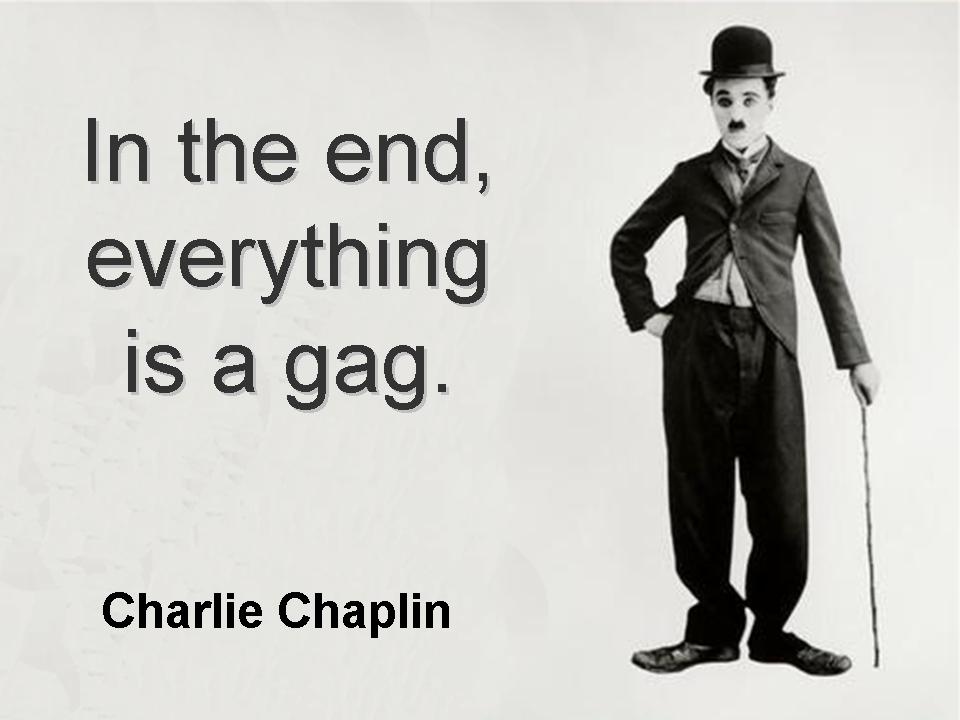
I am but one thing, and one thing only - and that is a clown. It places me on a higher plane than any politician.
I don't believe that the public knows what it wants; this is the conclusion that I have drawn from my career.
The basic essential of a great actor is that he loves himself in acting
Despair is a narcotic. It lulls the mind into indifference.
I do not wish to lose my temper because very shortly I will lose my head. Nevertheless, upon leaving this spark of earthly existence, I have this to say: I shall see you all very soon ... very soon. (Mr Verdoux)
Humor is the sublime wisdom of pity and tolerance in which man recognizes the utter futility of his own enterprise and importance.
Humor is the ability to discern in a kindly way the folly in what is considered normal, sublime behavior, and to discern the discrepancy in what appears as a truth.
They walked out on me. They haven't done that since I was a beginner. The cycle's complete.
Doing something with the public in mind is doing something without your own mind.
A man's true character comes out when he's drunk.
The roses you lifted to your lips ... lucky roses!
Sunday, May 16, 2010
The Masterpiece Features
A Woman of Paris (1923)
was a courageous step in the career of Charles Chaplin. After seventy films in which he himself had appeared in every scene, he now directed a picture in which he merely walked on for a few seconds as an unbilled and unrecognizable extra – a porter at a railroad station. Until this time, every film had been a comedy. A Woman of Paris was a romantic drama. This was not a sudden impulse. For a long time Chaplin had wanted to try his hand at directing a serious film. In the end, the inspiration for A Woman of Paris came from three women. First was Edna Purviance, who had been his ideal partner in more than 35 films. Now, though, he felt that Edna was growing too mature for comedy, and decided to make a film that would launch her on a new career as a dramatic actress.
The Gold Rush (1925)
Chaplin generally strove to separate his work from his private life; but in this case the two became inextricably and painfully mixed. Searching for a new leading lady, he rediscovered Lillita MacMurray, whom he had employed, as a pretty 12-year-old, in The Kid Still not yet sixteen, Lillita was put under contract and re-named Lita Grey. Chaplin quickly embarked on a clandestine affair with her; and when the film was six months into shooting, Lita discovered she was pregnant. Chaplin found himself forced into a marriage which brought misery to both partners, though it produced two sons, Charles Jr and Sydney Chaplin.
The Circus (1928)
“The Circus” won Charles Chaplin his first Academy Award – it was still not yet called the ‘Oscar’ – he was given it at the first presentations ceremony, in 1929. But as late as 1964, it seemed, this was a film he preferred to forget. The reason was not the film itself, but the deeply fraught circumstances surrounding its making. Chaplin was in the throes of the break-up of his marriage with Lita Grey; and production of The Circus coincided with one of the most unseemly and sensational divorces of twenties Hollywood, as Lita’s lawyers sought every means to ruin Chaplin’s career by smearing his reputation.
As if his domestic troubles were not enough, the film seemed fated to catastrophe of every kind […]
In the late 1960s, after the years spent trying to forget it, Chaplin returned to “The Circus” to re-release it with a new musical score of his own composition. […] It seemed to symbolize his reconciliation to the film which cost him so much stress.
City Lights (1931)
“City Lights” proved to be the hardest and longest undertaking of Chaplin’s career. By the time it was completed he had spent two years and eight months on the work, with almost 190 days of actual shooting. The marvel is that the finished film betrays nothing of this effort and anxiety. Even before he began City Lights the sound film was firmly established. This new revolution was a bigger challenge to Chaplin than to other silent stars. His Tramp character was universal. His mime was understood in every part of the world. But if the Tramp now began to speak in English, that world-wide audience would instantly shrink.
Chaplin boldly solved the problem by ignoring speech, and making City Lights in the way he had always worked before, as a silent film. [However] he astounded the press and the public by composing the entire score for “City Lights”. The premieres were among the most brilliant the cinema had ever seen. In Los Angeles, Chaplin’s guest was Albert Einstein; while in London Bernard Shaw sat beside him. “City Lights” was a critical triumph. All Chaplin’s struggles and anxieties, it seemed, were compensated by the film which still appears as the zenith of his achievement and reputation.
Modern Times (1936)
Chaplin was acutely preoccupied with the social and economic problems of this new age. In 1931 and 1932 he had left Hollywood behind, to embark on an 18-month world tour. In Europe, he had been disturbed to see the rise of nationalism and the social effects of the Depression, of unemployment and of automation. He read books on economic theory; and devised his own Economic Solution, an intelligent exercise in utopian idealism, based on a more equitable distribution not just of wealth but of work. In 1931 he told a newspaper interviewer, “Unemployment is the vital question . . . Machinery should benefit mankind. It should not spell tragedy and throw it out of work”.
The Great Dictator (1940)
When writing “The Great Dictator” in 1939, Chaplin was as famous worldwide as Hitler, and his Tramp character wore the same moustache. He decided to pit his celebrity and humour against the dictator’s own celebrity and evil. He benefited – if that is the right word for it, given the times – from his “reputation” as a Jew, which he was not – (he said “I do not have that pleasure”). In the film Chaplin plays a dual role –a Jewish barber who lost his memory in a plane accident in the first war, and spent years in hospital before being discharged into an antisemite country that he does not understand, and Hynkel, the dictator leader of Ptomania, whose armies are the forces of the Double Cross, and who will do anything along those lines to increase his possibilities for becoming emperor of the world. Chaplin’s aim is obvious, and the film ends with a now famous and humanitarian speech made by the barber, speaking Chaplin’s own words .
Monsieur Verdoux (1947)
The idea was originally suggested by Orson Welles, as a project for a dramatized documentary on the career of the legendary French murder Henri Désiré Landru – who was executed in 1922, having murdered at least ten women, two dogs and one boy. Chaplin was so intrigued by the idea that he paid Welles $5000 for it. The agreement was signed in 1941, but Chaplin took four more years to complete the script. In the meantime the irritating distractions of a much-publicized and ugly paternity suit had been compensated by his brilliantly successful marriage to Oona O’Neill. In the late 1940s, America¹s Cold War paranoia reached its peak, and Chaplin, as a foreigner with liberal and humanist sympathies, was a prime target for political witch-hunters. This was the start of Chaplin’s last and unhappiest period in the United States, which he was definitively to leave in 1952.
Limelight (1952)
Not surprisingly, then, in choosing his next subject he deliberately sought escape from disagreeable contemporary reality. He found it in bitter-sweet nostalgia for the world of his youth – the world of the London music halls at the opening of the 20th century, where he had first discovered his genius as an entertainer. With this strong underlay of nostalgia, Chaplin was at pains to evoke as accurately as possible the London he remembered from half a century before and it is clear from the preparatory notes for the film that the character of Calvero had a very similar childhood to Chaplin’s own. Limelight s story of a once famous music hall artist whom nobody finds amusing any longer may well have been similarly autobiographical as a sort of nightmare scenario. Chaplin’s son Sydney plays the young, talented pianist who vies with Calvero for the young ballerina’s heart, and several other Chaplin family members participated in the film. It was when on the boat traveling with his family to the London premiere of Limelight that Chaplin learned that his re-entry pass to the United States had been rescinded based on allegations regarding his morals and politics. Chaplin therefore remained in Europe, and settled with his family at the Manoir de Ban in Corsier sur Vevey, Switzerland, with view of lake and mountains. What a difference from California. He and Oona went on to have four more children, making a total of eight.
A King in New York
With A King in New York Charles Chaplin was the first film-maker to dare to expose, through satire and ridicule, the paranoia and political intolerance which overtook the United States in the Cold War years of the 1940s and 50s.
Chaplin himself had bitter personal experience of the American malaise of that time. […]
To take up film making again, as an exile, was a challenging undertaking. He was now nearing 70. For almost forty years he had enjoyed the luxury of his own studio and a staff of regular employees, who understood his way of work. Now though he had to work with strangers, in costly and unfriendly rented studios. […] The film shows the strain.
In 1966 he produced his last picture, “A Countess from Hong Kong” for Universal Pictures, his only film in colour, starring Sophia Loren and Marlon Brando. The film started as a project called Stowaway in the 1930s, planned for Paulette Goddard. Chaplin appears briefly as a ship steward, Sydney once again has an important role, and three of his daughters have small parts in the film. The film was unsuccessful at the box office, but Petula Clark had one or two hit records with songs from the soundtrack music and the music continues to be very popular.
Last Years
Chaplin’s versatility extended to writing, music and sports. He was the author of at least four books, “My Trip Abroad”, “A Comedian Sees the World”, “My Autobiography”, “My Life in Pictures” as well as all of his scripts. An accomplished musician, though self-taught, he played a variety of instruments with equal skill and facility (playing violin and cello left-handed).
He was also a composer, having written and published many songs, among them: “Sing a Song”; “With You Dear in Bombay”; and “There’s Always One You Can’t Forget”, “Smile”, “Eternally”, “You are My Song”, as well as the soundtracks for all his films.
Charles Chaplin was one of the rare comedians who not only financed and produced all his films (with the exception of “A Countess from Hong Kong”), but was the author, actor, director and soundtrack composer of them as well. He died on Christmas day 1977, survived by eight children from his last marriage with Oona O’Neill, and one son from his short marriage to Lita Grey.